
Retinal Diseases: Diagnosis and Treatment
Your retina is one of the most vital structures in your eye. This thin layer of tissue at the back of the eye converts light into the signals your brain interprets as vision. When the retina is damaged or diseased, the consequences can range from subtle visual disturbances to permanent vision loss. At NY LASIK, serving patients across New York City, Manhattan, Brooklyn, and the greater New York area, our team provides comprehensive diagnosis and treatment for a full range of retinal conditions, from dry macular degeneration and diabetic retinopathy to retinal detachment and flashes and floaters.
Retinal diseases are more common than many people realize. According to the National Eye Institute, millions of Americans are affected by retinal conditions at any given time, and many cases go undetected until significant vision loss has already occurred.1 Early diagnosis and timely treatment are critical to preserving your sight.
Whether you have been referred by your primary care physician or optometrist, or you are experiencing new visual symptoms, our team is here to help you understand your condition and your options.

Retinal Conditions We Treat
NY LASIK offers evaluation and treatment for a broad spectrum of retinal diseases. Led by Leonard Bley, MD, FACS and Moishe Szlecter, MD, our ophthalmologists use advanced diagnostic imaging, including optical coherence tomography (OCT) and fluorescein angiography, to accurately assess retinal health and guide individualized treatment plans. Patients throughout NYC can access comprehensive retinal care close to home.

Dry Macular Degeneration
Age-related macular degeneration (AMD) is the leading cause of vision loss in adults over 50 in the United States, according to the American Academy of Ophthalmology. The dry form of AMD is the most common type, accounting for approximately 80 to 90 percent of all AMD cases.2 It occurs when the macula, the central part of the retina responsible for sharp, detailed vision, gradually thins and breaks down over time.
Symptoms of dry AMD may include:
- Blurred or reduced central vision
- Difficulty reading or recognizing faces
- The need for brighter light when performing close-up tasks
- A blurry or blind spot in the center of your visual field
While there is currently no cure for dry AMD, early detection allows our team to monitor progression closely and recommend lifestyle modifications and nutritional supplementation that may slow its advance. Research from the National Eye Institute has shown that the AREDS2 formula of vitamins and minerals can reduce the risk of progression to advanced AMD in certain patients.3
Until recently, these measures represented the primary tools available for managing dry AMD. Advances in photobiomodulation technology have changed that, offering patients an active, non-invasive treatment option where few existed before.
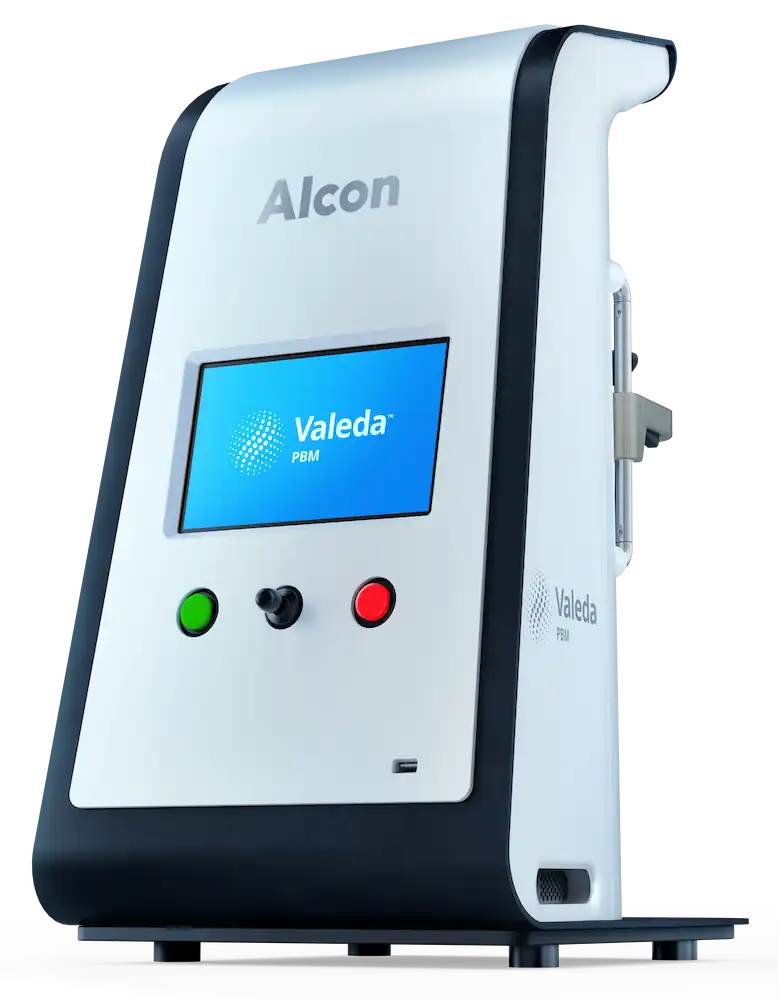
Valeda Light Therapy for Dry AMD
For patients with dry AMD, NY LASIK now offers Valeda Light Delivery System therapy, one of only a handful of units available in the greater NYC metro area and one of the only providers in Brooklyn with this technology. Valeda uses photobiomodulation (PBM) to deliver gentle, low-level light energy to the retina. Treatments are painless, require no medication, and are completed in under five minutes per eye with no downtime.
Medicare and most Medicare Advantage plans cover Valeda therapy. Our team will confirm your coverage at the time of your consultation.

Wet AMD (Wet Macular Degeneration)
Wet AMD is a more advanced and aggressive form of age-related macular degeneration. It occurs when abnormal blood vessels grow beneath the retina and leak fluid or blood, causing rapid and severe central vision loss. Although wet AMD accounts for a smaller percentage of AMD cases, it is responsible for the majority of severe vision loss associated with the disease.
Symptoms of wet AMD include:
- Sudden or rapid worsening of central vision
- Straight lines appearing wavy or distorted
- A dark or empty area in the center of your vision
Wet AMD is treated with anti-VEGF (vascular endothelial growth factor) injections, which are administered directly into the eye to reduce abnormal blood vessel growth and leakage. According to the American Academy of Ophthalmology, anti-VEGF therapy has significantly improved outcomes for patients with wet AMD and can stabilize or even improve vision in many cases when treatment begins promptly.4
Diabetic Retinopathy
Diabetic retinopathy is a complication of diabetes that affects the blood vessels in the retina. Over time, high blood sugar levels damage these vessels, causing them to leak, swell, or grow abnormally. It is the leading cause of blindness among working-age adults in the United States.5
According to the Centers for Disease Control and Prevention, more than 40 million Americans have diabetes, and diabetic retinopathy affects a significant portion of those with long-standing disease.6 A 2021 study published in JAMA Ophthalmology, authored in part by researchers from the CDC’s Vision Health Initiative, found that an estimated 9.6 million people in the United States — roughly 26 percent of those with diabetes — were living with diabetic retinopathy.7 The condition often has no symptoms in its early stages, making routine eye exams essential for anyone living with diabetes.
Stages of diabetic retinopathy include:
- Non-proliferative diabetic retinopathy (NPDR): Early stage, characterized by microaneurysms and small retinal hemorrhages
- Proliferative diabetic retinopathy (PDR): Advanced stage, where new, fragile blood vessels grow on the retina and can cause vitreous hemorrhage or retinal detachment
Treatment options may include:
- Anti-VEGF injections to reduce swelling and abnormal vessel growth
- Laser photocoagulation to seal leaking blood vessels
- Vitrectomy surgery in advanced cases involving vitreous hemorrhage or traction retinal detachment

Flashes and Floaters
Flashes of light and floaters are among the most common visual complaints we see at NY LASIK. Floaters appear as spots, threads, or cobweb-like shapes drifting across your field of vision. Flashes look like brief streaks or sparks of light, often in your peripheral vision.
In many cases, floaters and flashes are caused by posterior vitreous detachment (PVD), a natural age-related process in which the vitreous gel inside the eye separates from the retina. While PVD itself is not dangerous, it can sometimes cause a retinal tear or detachment, which requires urgent treatment.
When to seek immediate care:
- A sudden increase in the number of floaters
- New flashes of light, especially in one eye
- A shadow or curtain appearing in your peripheral vision
- Any sudden change in vision
If you are experiencing new or worsening flashes and floaters in NYC, Manhattan, Brooklyn, or anywhere in New York, do not wait. Contact NY LASIK promptly so our team can evaluate your retina and rule out a retinal tear or detachment.
Retinal Detachment
Retinal detachment is a medical emergency. It occurs when the retina separates from the underlying tissue that supplies it with oxygen and nutrients. Without prompt treatment, retinal detachment can cause permanent vision loss.
Warning signs of retinal detachment include:
- A sudden shower of new floaters
- Flashes of light in one or both eyes
- A dark shadow or curtain spreading across your visual field
- Blurred or distorted vision
If you experience any of these symptoms, seek care immediately. Retinal detachment is treated surgically, and the sooner treatment begins, the better the visual outcome. Research published in peer-reviewed ophthalmology literature consistently shows that visual outcomes following retinal detachment repair are significantly better when surgery is performed before the macula becomes detached.8
Surgical treatment options for retinal detachment include:
- Pneumatic retinopexy: A gas bubble is injected into the eye to push the retina back into place
- Scleral buckling: A silicone band is placed around the eye to support the detached retina
- Vitrectomy: The vitreous gel is removed and replaced to allow the retina to reattach

Why Choose NY LASIK for Retinal Disease Care
At NY LASIK, we believe that comprehensive eye care means more than vision correction. Our practice is built on the principle that every patient deserves access to the full spectrum of ophthalmic services, from LASIK and cataract surgery to the diagnosis and management of complex retinal conditions, all under one roof.
Our ophthalmologists bring advanced training in retinal disease evaluation and management, utilizing state-of-the-art diagnostic tools including optical coherence tomography (OCT), fluorescein angiography, and fundus photography to deliver precise, individualized care. Our team is trained in the full range of retinal treatment modalities, including anti-VEGF injections, laser photocoagulation, and surgical intervention.
NY LASIK is a division of the Laser and Microsurgery Institute, a multi-specialty ophthalmology organization with a long-standing commitment to clinical excellence across New York City. Our offices are conveniently located in Manhattan, Brooklyn, and Queens, making it easy for patients throughout New York to access the retinal care they need close to home.
Common warning signs include sudden floaters, flashes of light, blurred or distorted central vision, a shadow or curtain in your peripheral vision, and difficulty seeing in low light. If you notice any of these symptoms, schedule an evaluation as soon as possible.
Yes. Retinal detachment is a medical emergency that requires prompt surgical treatment. If you experience a sudden increase in floaters, new flashes of light, or a shadow spreading across your vision, contact NY LASIK immediately or go to an emergency eye care facility. The sooner treatment begins, the better the chance of preserving your vision.
Your first visit will typically include a comprehensive dilated eye exam, a review of your medical and ocular history, and advanced retinal imaging such as optical coherence tomography (OCT). Based on these findings, our team will discuss your diagnosis and recommend a personalized treatment plan.
While diabetic retinopathy cannot always be prevented, its progression can often be slowed significantly with good blood sugar control, regular blood pressure management, and routine dilated eye exams. The American Diabetes Association recommends that all people with diabetes receive a comprehensive dilated eye exam at least once a year.9
Dry AMD is the more common form and progresses slowly over time as the macula gradually thins. Wet AMD is less common but more aggressive, caused by abnormal blood vessel growth beneath the retina. Wet AMD can cause rapid vision loss and requires prompt treatment with anti-VEGF injections.
Not always. Many floaters are harmless and related to normal age-related changes in the vitreous gel. However, a sudden increase in floaters, especially when accompanied by flashes of light or a shadow in your vision, can indicate a retinal tear or detachment and should be evaluated urgently.
NY LASIK offers retinal disease evaluation and treatment at convenient locations throughout NYC, Manhattan, Brooklyn, and the greater New York area. Our team is ready to see you promptly, including for urgent concerns. Contact us today to schedule your consultation.
1 National Eye Institute. Eye Disease Statistics. Available: https://www.nei.nih.gov/sites/default/files/2019-04/NEI_Eye_Disease_Statistics_Factsheet_2014_V10.pdf. Accessed April 23, 2026.
2 American Academy of Ophthalmology. Understanding Macular Degeneration. Available: https://www.aao.org/eye-health/diseases/amd-macular-degeneration. Accessed April 23, 2026.
3 National Eye Institute. NIH study confirms benefit of supplements for slowing age-related macular degeneration. Available: https://www.nei.nih.gov/research-and-training/research-news/nih-study-confirms-benefit-supplements-slowing-age-related-macular-degeneration. Accessed April 23, 2026.
4 American Academy of Ophthalmology. Anti-VGEF Treatments. Available: https://www.aao.org/eye-health/drugs/anti-vegf-treatments. Accessed April 23, 2026.
5 Centers for Disease Control and Prevention. Vision Loss and Diabetes. Available: https://www.cdc.gov/diabetes/diabetes-complications/diabetes-and-vision-loss.html. Accessed April 23, 2026.
6 Centers for Disease Control and Prevention. National Diabetes Statistics Report. Available: https://www.cdc.gov/diabetes/php/data-research/index.html. Accessed April 23, 2026.
7 Prevent Blindness. Study Finds Significantly More Adults Living with Diabetic Retinopathy in the United States than Previously Estimated. Available: https://preventblindness.org/study-diabetic-retinopathy-estimates/. Accessed April 23, 2026.
8 American Academy of Ophthalmology. Time before repair of rhegmatogenous retinal detachment impacts visual acuity. Available: https://www.aao.org/education/editors-choice/time-before-repair-of-rhegmatogenous-retinal-detac. Accessed April 23, 2026.
9 American Diabetes Association. What You Need to Know About Diabetes and Your Eyes. Available: https://diabetes.org/health-wellness/eye-health. Accessed April 23, 2026.
The content on this page was authored and medically reviewed by Dr. Leonard M. Bley, MD, FACS, founder of NY LASIK and Surgical Director of Laser and Microsurgery Institute. Dr. Bley is an internationally recognized, board-certified refractive and cataract surgeon with over 35 years of clinical experience and more than 30,000 vision correction procedures performed across our Manhattan, Brooklyn, and Queens offices. A Fellow of the American Academy of Ophthalmology and member of the American College of Eye Surgeons, he trained at Manhattan Eye, Ear and Throat Hospital and completed fellowship training at New York University Hospital, with hospital affiliations at NYU Langone and Staten Island University Hospital. By combining decades of surgical expertise with a commitment to evidence-based, patient-centered care, our team ensures all content on this site reflects the most current and accurate information in refractive surgery, cataract care, and advanced eye health.